
Solutions · Process flow
We develop the equipment around the cheese and the process
Cheese production consists of closely linked process steps. Temperature, time, mechanical treatment, whey drainage, molding and pressing affect the product, the capacity and the handling that follows. That is why we start from the cheese type and the intended production – not from a standard machine.
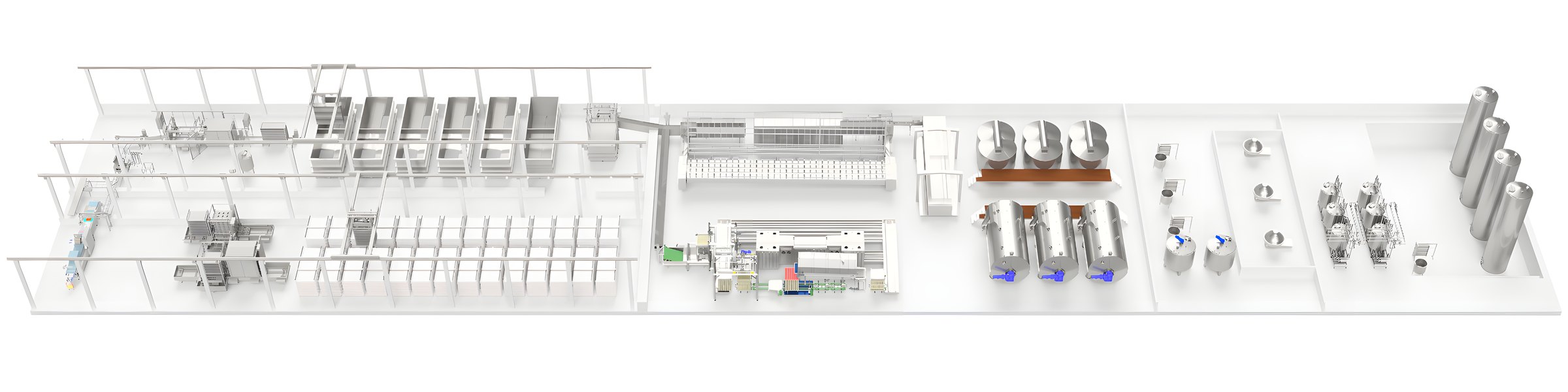
From milk to operation
The overall process flow
Use the flow as your entry point to solutions, equipment and expertise. Not every project includes every step, and the actual process varies with the cheese type and your production.
-
Step 1: Milk reception and pretreatment
What happensThe milk is standardized and treated in preparation for the intended cheese process.
What HSV Combi can contributeProcess and buffer tanks, pumps, valves, heat exchangers, piping, skid units, P&ID and automation.
-
Step 2: Addition and coagulation
What happensCultures, rennet and other ingredients are added under controlled process conditions.
What HSV Combi can contributeCheese vats, dosing, temperature control, stirring, instrumentation and process integration.
-
Step 3: Cutting and treatment
What happensThe coagulum is cut and treated so that curd grains and whey develop the desired properties.
What HSV Combi can contributeCheese vats, cutting tools, stirring, heating and cooling functions, and controls.
This is where the process splits. Different cheeses require different principles for draining, molding and pressing.
See the two process routes-
Step 4: Whey drainage and draining
What happensWhey is separated from the curd grains in a controlled way, according to the product and the process principle.
What HSV Combi can contributeCurd buffer tanks, drainage belts, vibrating screens, whey and fines handling.
-
Step 5: Molding and pressing
What happensThe curd is distributed, molded and pressed according to cheese type, capacity and weight requirements.
What HSV Combi can contributeCurd distributors, pre-presses, filling matrices, mold fillers, self-pressing and cheese presses.
-
Step 6: Demolding and internal handling
What happensCheeses, molds, lids and racks are moved safely between the next process steps.
What HSV Combi can contributeDemolders, conveyors, buffers, block molds, and XY and XYZ gantry systems.
-
Step 7: Brining
What happensThe cheese is salted according to the chosen method and residence time.
What HSV Combi can contributeBrine tanks, brining racks, loading, unloading, conveying and automatic crane systems.
-
Step 8: Ripening and storage
What happensProduct, position, residence time, turning and internal logistics are controlled throughout ripening.
What HSV Combi can contributeRipening racks, rack conveying, turning, automatic handling and traceable process control.
-
Step 9: Washing and hygiene
What happensEquipment, molds, lids, cheeses and racks are cleaned between production runs.
What HSV Combi can contributeMold, lid, cheese and rack washers, CIP, CIP-compatible conveyors and documentation.
-
Step 10: Operation and optimization
What happensThe plant is kept stable and developed in step with the needs of production.
What HSV Combi can contributeCommissioning, HSV Service, maintenance, spare parts, retrofit and ongoing optimization.
You decide the scope
Process knowledge as part of the delivery
We can deliver a single process step, a complete production line or a turnkey plant. The value lies in understanding the connections between product, equipment, capacity, hygiene, automation, people and the existing factory.
Scope note
The flow shows where we can contribute as a process and solution partner. It does not mean that every process step or component mentioned is included in every delivery. The actual scope is described on each solution and case.
Next step
Talk to us about your process
Tell us about the cheese type, the capacity and the production the equipment has to work in. We will find the specialist who fits your project.
Feel free to attach drawings, photos or video of your current production.